

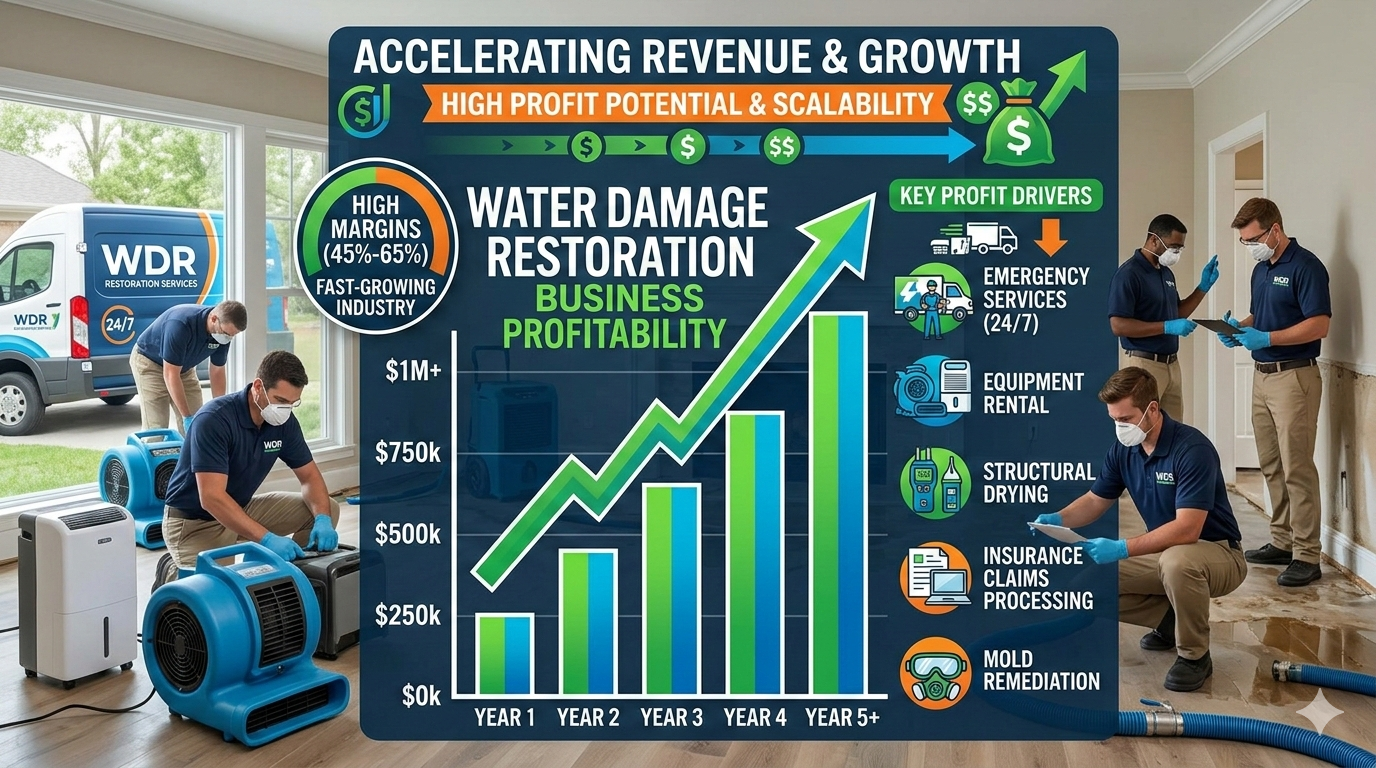
Water Damage Restoration Business Profitability in 2026 is strong — and in many markets, it outperforms traditional home service businesses. Why? Because water damage is urgent, non-optional, and often covered by insurance. When a pipe bursts at 2 a.m. or a storm floods a property, the homeowner is not shopping for the cheapest bid. They need immediate help.
A properly structured restoration company can generate between $250,000 and $700,000+ in annual owner earnings depending on size, staffing, and reconstruction capabilities. Larger multi-crew operations can exceed $1 million in Seller’s Discretionary Earnings (SDE). However, profitability depends on response speed, equipment utilization, labor control, and insurance billing efficiency.
In this guide, we break down how Water Damage Restoration Business Profitability actually works — using realistic revenue models, pricing structures, and margin expectations.
Quick Answer: Is Water Damage Restoration Profitable in 2026?
Yes. Water Damage Restoration Business Profitability remains high in 2026 because demand is consistent and recession-resistant. Properties continue to experience:
- Burst pipes
- Roof leaks
- Appliance failures
- Hurricane and storm damage
- Flooding and plumbing backups
Unlike discretionary services, restoration is a necessity.
Typical annual earnings by company size:
| Company Type | Annual Revenue | Net Margin | Owner Earnings (SDE) |
| Lean startup | $300k–$600k | 20%–30% | $100k–$180k |
| 2–3 crew operation | $1M–$2.5M | 18%–28% | $250k–$500k |
| Multi-crew with reconstruction | $3M–$7M+ | 20%–32% | $600k–$1M+ |
These numbers assume disciplined operations and steady referral sources.
When evaluating earnings, investors focus on Seller’s Discretionary Earnings rather than simple net income. SDE includes:
- Owner salary
- Personal vehicle expenses
- Non-recurring costs
- One-time equipment purchases
Understanding this distinction is critical when analyzing deals. For a deeper explanation, see this breakdown of SDE vs EBITDA comparison.
Why Restoration Businesses Attract Investors
There are four reasons Water Damage Restoration Business Profitability draws investor attention.
-
Insurance-Backed Revenue
Most residential water losses are insurance claims. That means:
- Less price resistance
- Standardized billing frameworks
- Higher average ticket sizes
While payment cycles can take 30–90 days, the overall job values are significantly larger than many home service calls.
-
High Average Ticket Size
Unlike HVAC repair or plumbing service calls averaging $500–$1,200, restoration jobs often range from:
- $3,000 to $10,000 for mitigation
- $15,000 to $40,000+ when reconstruction is included
Higher ticket size means fewer jobs are required to reach meaningful revenue.
-
Emergency-Based Demand
Restoration companies operate 24/7. Speed matters.
The first company to respond often wins the job. Businesses with:
- Rapid dispatch systems
- On-call technicians
- Strong Google presence
consistently outperform competitors.
-
Add-On Revenue Streams
Mitigation leads to additional services:
- Mold remediation
- Structural drying
- Demolition
- Reconstruction
- Contents cleaning
The companies that control the entire project lifecycle generate significantly higher margins.
How a Water Damage Restoration Business Makes Money
Understanding revenue structure is central to Water Damage Restoration Business Profitability.
Emergency Water Extraction
This is the initial service provided after water intrusion.
Typical billing components include:
- Emergency service call fee ($500–$1,500)
- Water extraction labor charges
- Equipment setup charges
A moderate residential job might generate:
$2,500–$6,000 during the first visit.
Fast response time improves close rates and reduces the chance of competitors taking over the job.
Drying and Equipment Rental
Drying equipment generates strong revenue because it is billed daily.
Equipment typically includes:
- Air movers
- Commercial dehumidifiers
- Air scrubbers
- Moisture monitoring tools
Example:
- 10 air movers at $40 per day
- 2 dehumidifiers at $125 per day
- 4-day drying cycle
Daily revenue:
(10 × $40) + (2 × $125) = $400 + $250 = $650
Over 4 days:
$650 × 4 = $2,600
This is in addition to labor and monitoring charges.
High equipment utilization directly improves Water Damage Restoration Business Profitability.
Mold Remediation
If moisture is not properly addressed, mold growth may occur.
Mold remediation jobs typically range from:
$2,000 to $12,000+
Margins can be strong but require:
- Proper licensing
- Specialized containment procedures
- Higher liability insurance
Companies that include mold services increase overall project value significantly.
Reconstruction Services
This is where profitability expands dramatically.
After mitigation and drying, many properties require:
- Drywall replacement
- Flooring installation
- Cabinet replacement
- Painting
- Roofing repairs
A $7,000 mitigation job can turn into a $25,000 total project once reconstruction is included.
Companies that do not offer reconstruction often refer that portion out — leaving substantial revenue untapped.
Commercial & Property Management Contracts
Some restoration companies secure relationships with:
- Property management firms
- Apartment complexes
- Hotels
- Office buildings
These contracts create recurring emergency revenue and stabilize cash flow.
Commercial jobs tend to have higher ticket sizes but require more documentation and compliance.
Insurance Billing Model and Cash Flow Considerations
Restoration companies typically use standardized estimating software to bill insurance carriers. This creates:
- Transparent pricing
- Consistent margins
- Documentation-heavy processes
However, payment delays are common. It is not unusual for insurance reimbursement to take:
30 to 90 days
Because of this delay, working capital is essential. Payroll, fuel, equipment payments, and insurance premiums must be covered while waiting for reimbursement.
Financing is often used to support growth. SBA-backed loans are common in this industry. To evaluate payment structures, you can model scenarios using an SBA loan calculator.
Cash flow management separates profitable operators from struggling ones.
Profit Margins by Business Model Type
Water Damage Restoration Business Profitability varies significantly depending on structure. A lean operator running one van has a completely different margin profile than a multi-crew reconstruction firm.
Let’s break down the most common models.
Model 1: Lean Owner-Operator Restoration Company
Profile:
- 1 van
- 1–2 technicians
- Focus on mitigation only
- Limited reconstruction capability
Revenue Range: $300,000–$600,000 annually
Net Margin: 20%–30%
Owner Earnings (SDE): $100,000–$180,000
Strengths:
- Low overhead
- Lower payroll risk
- Faster break-even
Weaknesses:
- Income capped by technician capacity
- Limited ability to scale
- Must subcontract reconstruction
This model can be very profitable but relies heavily on the owner’s involvement.
Model 2: 2–3 Crew Residential Restoration Company
Profile:
- 2–3 service vans
- 4–8 technicians
- Dedicated office/admin support
- Reconstruction included
Revenue Range: $1M–$2.5M
Net Margin: 18%–28%
Owner Earnings (SDE): $250,000–$500,000
Strengths:
- Higher ticket size
- Ability to handle multiple losses simultaneously
- Better referral leverage
Weaknesses:
- Higher workers’ compensation exposure
- Larger payroll burden
- Greater insurance complexity
This is where Water Damage Restoration Business Profitability becomes serious. Proper systems and scheduling determine whether the business earns $250k or $500k annually.
Model 3: Multi-Crew Commercial Restoration Firm
Profile:
- 4–8 crews
- Dedicated project managers
- Large loss commercial capabilities
- Strong reconstruction division
Revenue Range: $3M–$7M+
Net Margin: 20%–32%
Owner Earnings (SDE): $600,000–$1M+
Strengths:
- Large commercial contracts
- High-ticket projects
- Strong valuation multiples
Weaknesses:
- Higher capital requirements
- Greater liability exposure
- Complex insurance negotiations
Commercial losses can exceed $100,000 per project. A few large jobs can significantly impact annual revenue.
Franchise vs Independent Profitability
Franchise restoration brands provide:
- National marketing
- Carrier program relationships
- Standardized systems
However, franchise fees typically range from:
- 6%–10% royalty
- 2%–4% marketing fees
Independents retain higher margins but must build referral networks on their own.
Franchise operators often scale faster, while independent operators may achieve higher long-term net margins.
Startup Costs Breakdown for a Restoration Company
Understanding startup investment is essential when modeling Water Damage Restoration Business Profitability.
Core Equipment Costs
Basic mitigation equipment includes:
| Equipment | Estimated Cost |
| Air movers (20 units) | $10,000–$20,000 |
| Dehumidifiers (5 units) | $10,000–$25,000 |
| Extractors | $5,000–$15,000 |
| Air scrubbers | $5,000–$12,000 |
| Moisture meters & tools | $3,000–$7,000 |
Total core equipment:
$40,000–$80,000
Equipment utilization rate is critical. Idle equipment reduces ROI.
Vehicles
Restoration vans must carry:
- Equipment racks
- Generators
- Extraction systems
Cost per vehicle:
$35,000–$70,000 depending on new vs used.
A 2-van startup may invest $80,000–$120,000 in vehicles.
Licensing & Certifications
Common certifications include:
- IICRC Water Damage Restoration Technician (WRT)
- Applied Structural Drying (ASD)
- Mold remediation certifications
Training costs:
$3,000–$10,000 initially.
Proper certification increases credibility and insurance carrier acceptance.
Insurance Requirements
Insurance is a major cost driver.
Typical annual costs:
- General liability: $8,000–$25,000
- Workers’ compensation: 15%–30% of payroll
- Commercial auto: $4,000–$10,000 per vehicle
- Pollution liability (mold coverage): additional premium
Insurance costs heavily impact Water Damage Restoration Business Profitability.
Working Capital Requirements
Because insurance payments are delayed, working capital is critical.
A safe estimate is:
3 months of operating expenses.
For a company with $80,000 in monthly expenses, that equals:
$240,000 in working capital buffer.
Many owners finance part of their startup using SBA-backed loans. Payment modeling can be calculated using the SBA loan calculator.
Monthly Revenue Examples with Real Numbers
Now let’s walk through practical math.
Low Case Scenario: Lean Startup
Assumptions:
- 6 jobs per month
- Average mitigation ticket: $5,000
Monthly revenue:
6 × $5,000 = $30,000
Monthly expenses:
| Expense | Cost |
| Technician wages | $8,000 |
| Insurance | $4,000 |
| Vehicle payment | $1,500 |
| Fuel | $1,200 |
| Equipment financing | $2,000 |
| Admin/marketing | $3,000 |
| Miscellaneous | $2,000 |
| Total | $21,700 |
Monthly profit:
$30,000 – $21,700 = $8,300
Annualized:
$99,600
Lean but stable.
Mid Case Scenario: 2–3 Crew Operation
Assumptions:
- 18 jobs per month
- Average ticket: $8,000
Monthly revenue:
18 × $8,000 = $144,000
Monthly expenses:
| Expense | Cost |
| Payroll | $45,000 |
| Workers’ comp | $10,000 |
| Insurance | $8,000 |
| Fuel | $4,000 |
| Equipment financing | $8,000 |
| Admin | $7,000 |
| Marketing | $6,000 |
| Miscellaneous | $6,000 |
| Total | $94,000 |
Monthly profit:
$144,000 – $94,000 = $50,000
Annualized:
$600,000
This demonstrates the scalability of Water Damage Restoration Business Profitability when systems are in place.
High Case Scenario: Commercial Operator
Assumptions:
- 25 jobs per month
- Average ticket: $15,000
Monthly revenue:
25 × $15,000 = $375,000
Monthly expenses:
Approximately $250,000
Estimated monthly profit:
$125,000
Annualized:
$1.5 million
Large commercial jobs significantly increase revenue concentration.
Insurance Payment Timing and Cash Flow Cycles
Even profitable companies can struggle if cash flow is mismanaged.
If average payment delay is 60 days:
- Month 1 revenue not received until Month 3
- Payroll must be covered during delay
This makes working capital management just as important as gross margins.
Buyers evaluating acquisitions carefully review receivables aging reports during the due diligence process for business buyers.
Break-even Analysis for Water Damage Restoration
Understanding break-even is essential to protecting Water Damage Restoration Business Profitability. Because this industry has high payroll and insurance expenses, knowing your exact break-even point prevents cash flow surprises.
Fixed vs Variable Costs Explained
Fixed Monthly Costs (expenses that do not change with job volume):
- Office/admin payroll
- Vehicle payments
- Equipment financing
- Insurance premiums
- Software subscriptions
- Marketing retainers
- Rent (if applicable)
Example fixed monthly cost for a 2-crew company:
$70,000
Variable Costs Per Job (costs tied directly to each project):
- Technician labor hours
- Fuel
- Dump/disposal fees
- Consumables
- Subcontracted reconstruction labor
Example variable cost per job:
$3,000
Break-even Jobs Per Month Calculation
Assume:
Average ticket: $8,000
Variable cost per job: $3,000
Contribution margin per job:
$8,000 – $3,000 = $5,000
Now divide fixed costs by contribution margin:
$70,000 ÷ $5,000 = 14 jobs
This means the company must complete 14 jobs per month just to break even.
If they complete 18 jobs monthly:
18 – 14 = 4 profitable jobs
4 × $5,000 = $20,000 profit
That’s $240,000 annually beyond break-even.
This is how Water Damage Restoration Business Profitability scales quickly once minimum volume is achieved.
Time-to-Profit Expectations
Break-even timing depends on startup scale:
| Business Model | Estimated Time to Break Even |
| Lean startup | 3–6 months |
| 2–3 crew company | 6–9 months |
| Multi-crew commercial | 9–15 months |
Strong referral pipelines shorten this timeline significantly.
ROI & Payback Period Expectations
Restoration businesses often generate strong returns relative to startup investment.
Conservative ROI Model
Startup investment: $250,000
Annual SDE: $300,000
Payback period:
$250,000 ÷ $300,000 = 0.83 years
Approximately 10 months.
Even if earnings drop to $220,000:
$250,000 ÷ $220,000 = 1.13 years
Just over one year.
Aggressive Growth Model
Startup investment: $500,000
Annual SDE: $800,000
Payback period:
$500,000 ÷ $800,000 = 0.63 years
About 7–8 months.
These projections assume:
- High equipment utilization
- Strong insurance relationships
- No major claims or lawsuits
Impact of Financing and SBA Leverage
Many acquisitions or expansions are financed.
Example:
Purchase price: $1,200,000
Down payment: 10% ($120,000)
Loan amount: $1,080,000
If annual SDE is $450,000 and annual debt service is $180,000:
Remaining cash flow:
$450,000 – $180,000 = $270,000
Leverage increases return on invested capital.
To model payments accurately, use the SBA loan calculator.
Key Profit Drivers That Increase Margins
Water Damage Restoration Business Profitability is not random. It responds directly to operational discipline.
- Insurance Relationships and Referral Pipelines
Plumbers, roofing contractors, and property managers generate consistent leads.
Companies with 3–5 strong referral partners often maintain predictable job flow.
Carrier program participation also increases volume but may reduce pricing flexibility.
- Response Time Advantage
The first company on-site often wins the job.
Investing in:
- 24/7 dispatch
- On-call technicians
- Strong local SEO
increases close rates dramatically.
Fast response reduces secondary damage, improving client satisfaction and referral potential.
- Equipment Utilization Rate
Idle equipment equals lost revenue.
If a company owns:
- 40 air movers
- 8 dehumidifiers
But only deploys half consistently, ROI suffers.
Tracking utilization rates improves capital efficiency.
- Reconstruction Integration
Mitigation-only companies cap revenue per job.
Companies that handle reconstruction internally:
- Increase ticket size
- Control project timeline
- Improve gross margins
A $6,000 mitigation job can turn into a $30,000 full restoration project.
- Administrative Efficiency
Accurate documentation, billing, and insurance negotiation prevent delayed payments.
Delayed reimbursement impacts cash flow more than gross margins.
Buyers reviewing acquisitions often examine receivables aging reports during the due diligence process for business buyers.
Risks That Can Hurt Water Damage Restoration Business Profitability
While strong, this industry carries meaningful risk.
Insurance Payment Delays
Claims disputes or documentation errors can delay payment for months.
Without adequate working capital, payroll pressure increases quickly.
Labor Shortages
Certified technicians are in demand.
Turnover increases training costs and reduces productivity.
Mold and Environmental Liability
Improper containment or remediation can lead to lawsuits.
Pollution liability insurance is essential but expensive.
Equipment Depreciation
Dehumidifiers and air movers degrade over time.
Failure to budget for replacement erodes long-term profitability.
FAQ: Water Damage Restoration Business Profitability
How much can a water damage restoration company make per year?
Small operators may earn $100,000–$180,000 annually.
Mid-size operators often earn $250,000–$500,000.
Larger firms can exceed $1 million in owner earnings.
What are average profit margins in restoration?
Net margins typically range from 18%–32% depending on scale and reconstruction capabilities.
Is water damage restoration recession-proof?
While not immune to economic shifts, water damage demand is largely necessity-driven and less sensitive to downturns than discretionary services.
How many jobs are needed to make $20,000 per month in profit?
If contribution margin per job is $5,000:
$20,000 ÷ $5,000 = 4 profitable jobs beyond break-even.
Is franchise restoration more profitable than independent?
Franchises may scale faster due to brand recognition but pay royalty fees. Independents often retain higher net margins over time.
What is the average valuation multiple?
Most small to mid-sized restoration companies sell for:
2.5x to 4x SDE
Example:
SDE: $400,000
Multiple: 3x
Estimated value:
$1,200,000
Understanding valuation structure is critical when preparing for exit. Reviewing frameworks like selling a service business in Fort Lauderdale provides additional positioning insight.
Strategic Insight for Investors and Buyers
Water Damage Restoration Business Profitability remains attractive in 2026 due to:
- Insurance-backed revenue
- High ticket sizes
- Add-on reconstruction potential
- Emergency-based demand
However, investors should focus on:
- Clean claims history
- Strong referral pipelines
- Equipment condition
- Accurate financial reporting
- Stable technician workforce
Companies with documented systems and recurring referral sources command stronger multiples and smoother exits.
When structured correctly, a restoration company is not simply a service provider — it becomes a scalable cash-flow asset capable of producing substantial annual returns.